What Is Queer Affirmative Therapy and Why Does It Matter in India?
If you have ever walked into a therapy room and spent the session explaining why your identity is valid rather than getting actual support, you understand exactly why queer affirmative therapy exists.
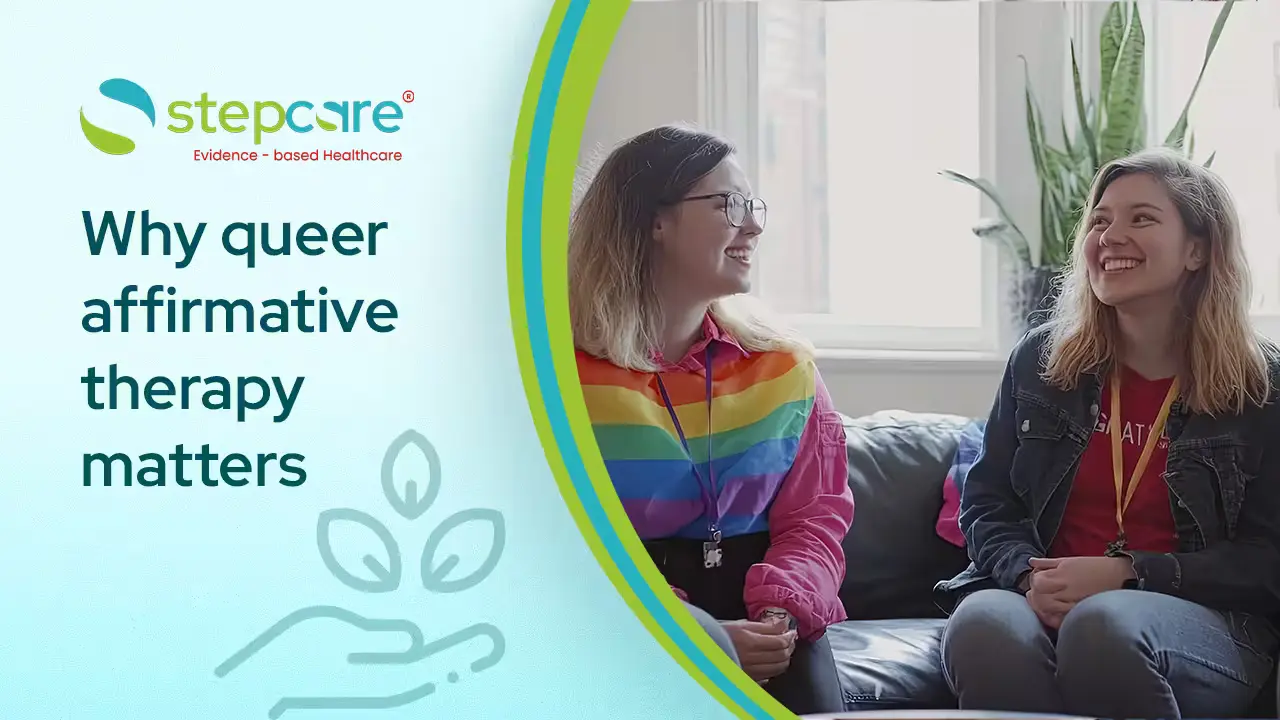
Queer affirmative therapy is a clinical approach that treats a person's sexual orientation and gender identity as a natural variation of human experience, not as a problem to be solved, managed, or changed. It is not a specific therapeutic technique like CBT or DBT. It is a framework and an orientation that shapes how a therapist shows up: the language they use, the assumptions they do not make, the power dynamics they stay aware of, and the space they actively create for you to be honest.
In India, where LGBTQIA+ individuals face layered stigma across family, community, workplace, and sometimes even healthcare settings, finding a therapist who is genuinely affirming rather than just tolerant can be the difference between therapy that heals and therapy that harms.
How Queer Affirmative Therapy Differs From Conventional Therapy
The Problem With a Heteronormative Default
In conventional therapy, the default frame is often heteronormative and cisnormative. That is not an accusation. It is a structural reality. Most mental health training curricula in India have historically not included meaningful LGBTQIA+ content. This means well-intentioned therapists can still ask a gay man why he has not tried dating women, or tell a non-binary person that they will understand their gender better once they are older. Those are not neutral responses. They cause harm.
Key Differences at a Glance
|
|
|
|
|
|
|
|
|
|
|
|
|
|
|
|
|
|
|
|
|
A queer affirmative therapist does not simply avoid saying harmful things. They actively create a space where a client does not have to manage the therapist's discomfort, educate them on LGBTQIA+ basics, or justify their own reality.
The Legal and Clinical Context in India
Section 377 and the Navtej Singh Johar Judgment (2018)
The reading down of Section 377 of the Indian Penal Code by the Supreme Court in the Navtej Singh Johar v. Union of India judgment in 2018 decriminalised consensual same-sex relations between adults. This was not just a legal shift. It changed what conversations are even possible between a client and a therapist without the spectre of criminalisation hanging over the room.
The Indian Psychiatric Society's Position on Homosexuality
The Indian Psychiatric Society's 2018 position statement formally affirmed that homosexuality is a sexual variation, not a mental illness. This aligned Indian psychiatry with the World Health Organization's position (homosexuality was removed from the International Classification of Diseases in 1990) and the American Psychiatric Association (which removed it from the DSM in 1973).
The Mental Healthcare Act, 2017
The Mental Healthcare Act of 2017 strengthened the rights of individuals to make decisions about their own mental health treatment, including the right not to be subjected to treatment that pathologises their identity.
Why Conversion Therapy Has No Place in Clinical Practice
Conversion therapy, which attempts to change a person's sexual orientation or gender identity through psychological or other interventions, is not only ineffective but causes documented psychological harm including depression, anxiety, and suicidality. It has no endorsement from any major medical or psychiatric body in India or globally.
What Is Minority Stress and Why Does It Matter in Therapy?
One of the most important clinical concepts in LGBTQ affirmative counselling is minority stress. Meyer's Minority Stress Model (1995, updated 2003) describes the unique, chronic stress that LGBTQIA+ individuals experience as a result of their marginalised position in society.
External Stressors
Discrimination, rejection, harassment, family non-acceptance, workplace hostility, and in some contexts, fear of legal consequences.
Internal Stressors
Internalised homophobia or transphobia (absorbing the negative messages society sends about your identity), concealment of identity to stay safe, and hypervigilance about how and when it is safe to be yourself.
How a Queer Affirmative Therapist Works With Minority Stress
The mental health impact of minority stress is well documented. Research consistently shows that LGBTQIA+ individuals report 2 to 3 times higher rates of anxiety and depression than the general population. Crucially, this is not because of their identity itself. It is because of how often that identity is invalidated, punished, or erased in the world around them.
A queer affirmative therapist does not treat anxiety or depression in a queer person as though it exists in a social vacuum. They name the minority stress explicitly, help the client separate what belongs to them personally and what is a rational response to an irrational environment, and work toward both internal resilience and, where possible, external change.
What Happens in a Queer Affirmative Counselling Session?
People often wonder what actually happens in the room differently. Here is what queer affirmative counselling looks like in practice, drawing on the Mariwala Health Initiative's QACP (Queer Affirmative Counselling Practice) framework, one of the most comprehensive Indian-context resources for this approach:
- The therapist uses affirming language from the first interaction. They ask your pronouns. They do not assume your relationship structure, your family configuration, or your gender experience. They do not use pathologising language.
- The intake process itself is adjusted. Forms do not force binary gender options. Questions about family and relationships are open-ended enough to include queer realities.
- The therapeutic focus is on what you come in with: anxiety about coming out, managing family rejection, relationship issues, career concerns, mental health symptoms, identity exploration, or any other reason someone seeks therapy. The affirmative framework shapes how those issues are understood and worked through, not what issues are allowed.
The American Psychological Association's guidelines for psychological practice with sexual minority persons are explicit: the goal is to respect the client's self-identification, avoid imposing heterosexual frameworks, and actively work to reduce the harm caused by societal stigma.
Is Queer Affirmative Therapy Available in India?
Yes, though access is uneven. Urban centres like Bangalore, Mumbai, Delhi, and Hyderabad have a growing number of trained queer affirmative therapists and counsellors. Organisations like the Mariwala Health Initiative have developed and delivered formal QACP training for mental health professionals, and their resource book is widely used as a foundational reference in India.
For people in smaller cities or towns, online therapy has expanded access significantly. Many queer affirmative therapists in India now offer video sessions, which removes the barrier of geography and sometimes the added barrier of not feeling safe being seen walking into a clinic.
Common Reasons LGBTQIA+ People Seek Therapy in India
While every person's reasons are their own, some of the most common issues that bring queer and trans individuals to therapy in the Indian context include:
- Anxiety and depression related to minority stress
- Family acceptance or rejection: navigating coming out decisions, managing estrangement, or working through a painful coming out experience
- Identity exploration: questions about sexual orientation, gender identity, or both
- Relationship concerns: navigating queer relationships in contexts that do not recognise or support them
- Workplace discrimination and professional impact
- Internalised shame: processing the messages absorbed from family, religion, or culture about being "wrong" or "broken"
- Trauma: including family-based trauma, conversion attempts, or harassment
- Life decisions: navigating marriage pressure, career choices, or relocation
- Trans-specific concerns: gender dysphoria, transition decisions, navigating healthcare systems
Queer affirmative counselling does not treat any of these as more or less legitimate than any other reason someone might seek therapy. It meets you where you are.
How to Explain Queer Affirmative Therapy to Someone Who Is Resistant
This question comes up often. A well-meaning family member who is struggling to understand the concept may ask why you need "special" therapy or worry about what it means.
The simplest framing is this: just as a therapist who specialises in grief is better placed to support someone who has lost a loved one, a queer affirmative therapist is better placed to support someone navigating the specific challenges of being LGBTQIA+. It is not about ideology. It is about fit, safety, and expertise.
Book a Queer Affirmative Counselling Session at Stepcare Whitefield
Stepcare's therapy and counselling team in Whitefield, Bangalore, offers a safe, non-judgmental space for LGBTQIA+ individuals. Sessions are available in person at Brigade IRV Centre, Whitefield, and online.
Call or WhatsApp+91 9606910113 / +91 9606910114
Emailappointments@stepcare.co.in
AddressG-01, Ground Floor, Brigade IRV Center, Nallurhalli, Whitefield, Bengaluru 560066
Your identity is not the problem. You deserve a therapist who knows that.
Need care guidance?
Book a consultation with Stepcare and get professional support for your health concern.
Book Appointment