

Thyroid Ultrasound in Whitefield: When Your Doctor Orders a Scan for Thyroid Nodules
If your doctor has ordered a thyroid ultrasound, the most common reason is that they felt a lump or swelling in your neck, or a blood test result prompted a closer look at the gland structure.
Here is the reassuring short answer: the overwhelming majority of thyroid nodules are benign. Studies consistently show that around 90 to 95 percent of thyroid nodules are non-cancerous. The ultrasound is done to identify the small proportion that need further assessment, not because cancer is expected.
What Is a Thyroid Ultrasound?
A thyroid ultrasound is a painless, radiation-free imaging test that uses high-frequency sound waves to produce detailed images of the thyroid gland in your neck. It is the single most useful imaging investigation for assessing thyroid structure.
It shows the size and shape of the gland, the presence, number, and size of any nodules, the internal characteristics of those nodules, blood flow patterns, and whether any neck lymph nodes appear abnormal.
Importantly, an ultrasound assesses structure, not function. It cannot tell you whether your thyroid is underactive or overactive. That requires a blood test (TSH, T4, T3). The two investigations answer different questions and are often ordered together.
Why Would a Doctor Order a Thyroid Ultrasound?
|
|
|
|
|
|
|
|
|
|
|
|
|
|
|
|
|
|
|
|
|
|
|
|
|
|
|
What the Radiologist Looks For: Nodule Characteristics
Not all nodules are treated the same way. The radiologist assesses several specific features that together determine whether further testing is needed:
Composition: Purely cystic (fluid-filled) nodules are almost always benign. Solid nodules warrant more attention.
Echogenicity: How the nodule reflects sound waves compared to surrounding tissue. Markedly hypoechoic (very dark) nodules carry higher suspicion.
Margins: Smooth, well-defined margins are reassuring. Irregular, lobulated, or infiltrative margins raise concern.
Shape: A nodule that is taller than it is wide on transverse view is a suspicious feature.
Calcifications: Microcalcifications (tiny bright spots) are a suspicious feature. Large coarse calcifications are usually less concerning.
Vascularity: Blood flow pattern within and around the nodule.
These features are combined into a risk classification system, most commonly TI-RADS (Thyroid Imaging Reporting and Data System), which assigns a risk category and guides whether a fine needle aspiration biopsy (FNAC) is recommended based on the nodule's size and risk features.
What Happens If a Nodule Needs Further Testing?
If the ultrasound identifies a nodule with suspicious features above the size threshold for its risk category, the next step is usually FNAC, a fine needle aspiration cytology.
FNAC involves inserting a very thin needle into the nodule, usually under ultrasound guidance, to collect cells for examination under a microscope. It is done as an outpatient procedure, takes a few minutes, and most patients describe it as comparable to a blood test in discomfort.
The result classifies the nodule using the Bethesda system, which guides whether observation, repeat FNAC, or surgery is appropriate.
Thyroid Ultrasound Cost in Bangalore
|
|
|
|
|
|
|
|
|
|
|
|
Costs vary by facility. Ultrasound requires no fasting, no injection, and no radiation exposure.
What to Expect During the Scan
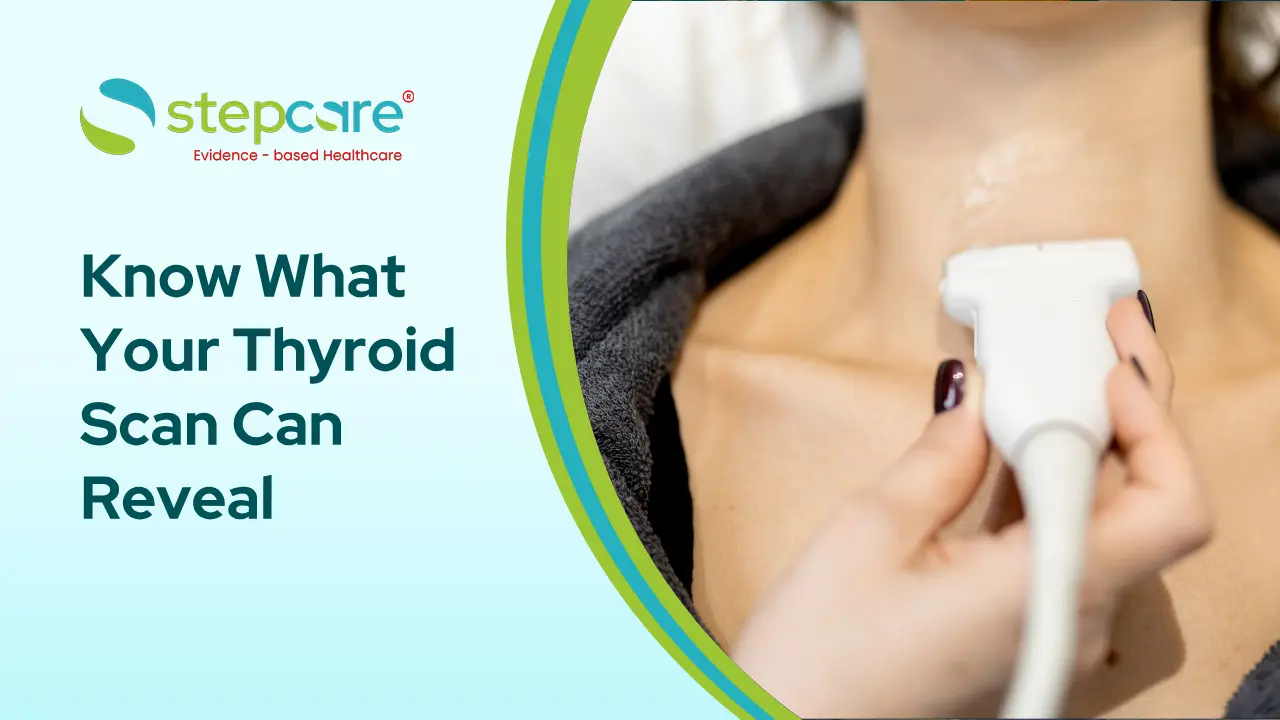
You lie on your back with a pillow under your shoulders to extend the neck slightly. A water-based gel is applied to the front of the neck. The radiologist moves a small probe over the area. The scan takes 10 to 20 minutes.
There is no pain, no radiation, and no preparation required. You can eat and drink normally beforehand and resume normal activity immediately after.
Should You Be Worried About a Thyroid Nodule?
Thyroid nodules are extremely common, particularly in women and with increasing age. Many people have them without knowing. The vast majority are benign, and even most thyroid cancers that are found are highly treatable with excellent long-term outcomes.
What matters is proper assessment: an ultrasound to characterise the nodule, thyroid function tests to assess gland activity, and FNAC only if the imaging features warrant it. Following that pathway means the small number of clinically significant nodules are identified without unnecessary intervention for the many that are not.
Book a Thyroid Ultrasound at Stepcare Whitefield
Stepcare's radiology department offers thyroid and soft tissue neck ultrasound alongside in-house thyroid function testing and physician consultation.
Call or WhatsApp: +91 9606910113 Email: appointments@stepcare.co.in Address: G-01, Ground Floor, Brigade IRV Center, Nallurhalli, Whitefield, Bengaluru 560066 Hours: Monday to Saturday, 8 AM to 8 PM | Sunday, 10 AM to 6 PM
Disclaimer: This content is for informational purposes only and should not be considered medical advice. Please consult a qualified healthcare professional before making any medical decisions.
Need care guidance?
Book a consultation with Stepcare and get professional support for your health concern.
Book Appointment